An employer asked to spend time on K–12 students is making a long bet. Most of the students are years from full-time work, and most won't end up working for that company. Studies from UK researchers and the OECD, published between 2012 and 2025, have looked at whether that time helps. Their answer is mostly yes, with caveats worth knowing before you repeat the numbers.
Career ideas form early
In 2018 the charity Education and Employers asked more than 20,000 children aged 7 to 11, in 20 countries, to draw the job they wanted when they grew up and say how they knew about it. Fewer than 1 percent said they had heard about the job from a volunteer from the world of work visiting their school. Education and Employers' summary of the study adds that the jobs seven-year-olds chose mirrored those picked by 17-year-olds.
Students who recalled more activities
The clearest evidence on volume comes from Contemporary Transitions, a 2017 Education and Employers study of 1,744 people in the UK aged 19 to 24. It asked how many school-organized activities involving employers they remembered from ages 14 to 19, such as work experience, mentoring, careers advice and workplace visits, then compared their situations as young adults. Its estimates of who ended up out of work, education or training adjust for qualifications, school type, family background and other characteristics.
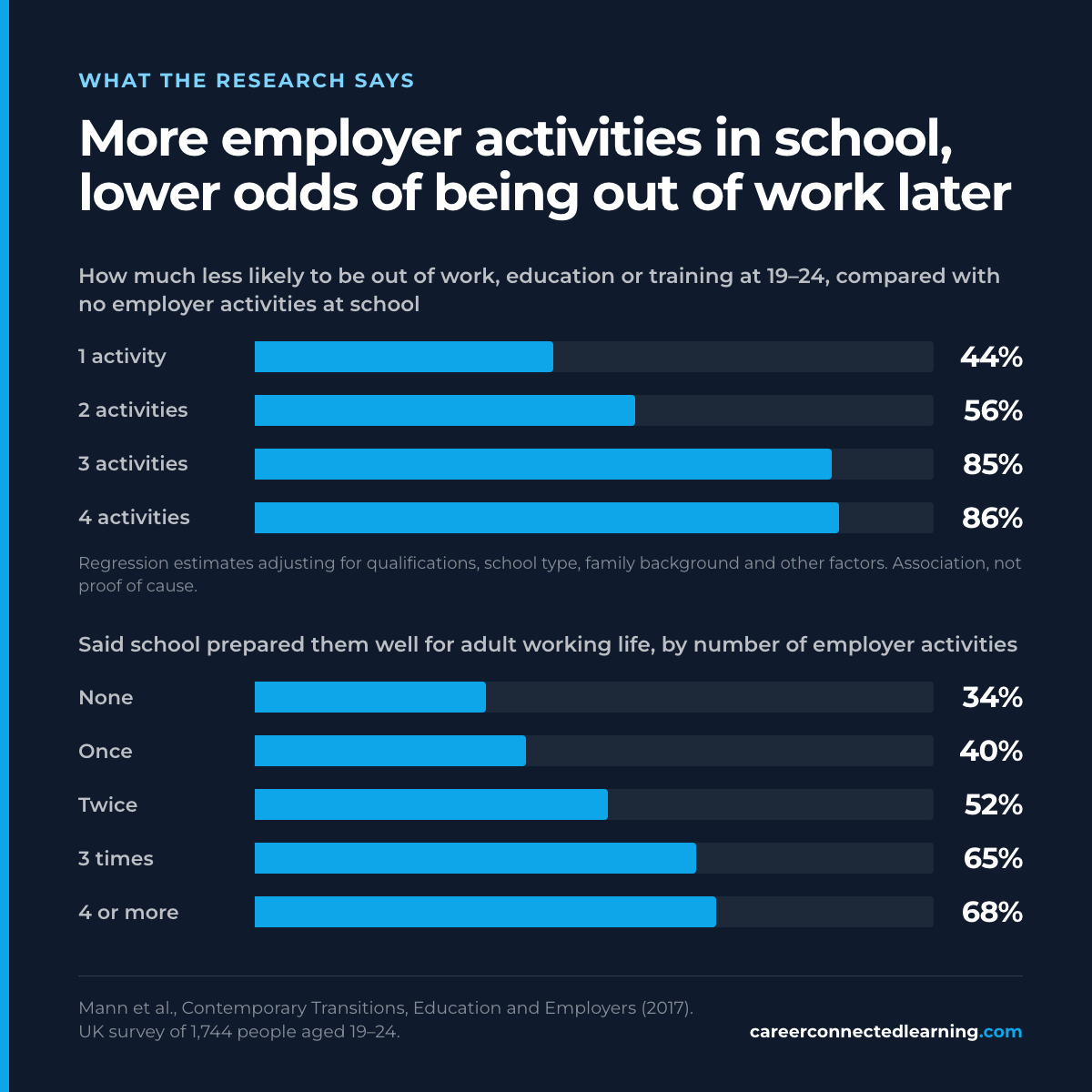
Compared with those who recalled no activities, young adults who recalled one were 44 percent less likely to be out of work, education or training. At four activities, the figure was 86 percent. The share who said school had prepared them well for working life rose with each activity, from 34 percent with none to 68 percent with four or more.
The study also looked at pay. Among respondents who found the activities helpful, each one was associated with 3.7 to 4.1 percent higher earnings, and four or more with 16.4 percent. Job shadowing before 16 was associated with 11 percent higher adult wages, though only 9 percent of respondents had done it. The authors recommend that schools aim for four or more employer interactions per student as a minimum.
Single activities in OECD data
In 2021 the OECD analyzed longitudinal data from several countries to find which teenage experiences were linked to better outcomes in adulthood. Three of its confirmed indicators of teenage career readiness involve employers: career talks or job fairs, workplace visits or job shadowing, and part-time work.
The associations are modest. Career talks by age 15 were linked to a 3-point lower chance of being out of work, education or training at 25 in Canada and Uruguay, but not to higher earnings. In Canada, people who went on an organized workplace visit by 15 were 4 percentage points less likely to be out of work, education or training at 25. In Australia, a school workplace visit by 15 or 16 was linked to 9 percent higher earnings at 25. In US data, students who did job shadowing or work-site visits at 13 or 14 earned about 10 percent more in their early twenties. That US result is significant only at the 10 percent level, and only 11 percent of the sample had done either activity.
What the evidence doesn't show
These studies find associations. The researchers adjust for background, but students who get more employer contact may still differ in ways the data doesn't capture.
Some popular figures also don't hold up well. The claim that employer contact leaves young people "five times less likely" to be out of work comes from a 2012 Education and Employers report that compared raw percentages (26.1 percent against 4.3 percent) without adjusting for background; the 2017 study above is the better source.
Internships have the weakest evidence of the group. The OECD found only partial evidence for work placements: six of eight studies found some employment benefit, but in US data the 5 percent of students who had done a teenage internship showed no significant association with being out of work or education, earnings or career satisfaction.
How much contact US students get
In Gallup's 2024 survey for the Walton Family Foundation, apart from learning about types of careers, each career-related activity it asked about was offered at the schools of 35 percent of students or fewer. Students whose schools offered those activities were 6 to 16 points more likely to feel very prepared for their future career. A 2024 survey of 1,100 young adults in Virginia, run with the OECD's methods, found that 49 percent had done a worksite visit and 51 percent job shadowing. That survey asked young adults what they had ever done, in or out of school, so its figures aren't directly comparable with Gallup's.
What this means for employers
Few employers can give every student in a district four activities, so it helps when a chamber or workforce board spreads the work across employers in a region. The OECD notes that employers find career talks the easiest activity to support, while workplace visits are "a bigger ask." Our guide for employers compares the options, including projects built into everyday classes.
Sources
- Education and Employers, Drawing the Future (2018)
- Education and Employers, "Drawing the Future report published" (2018)
- Mann, Kashefpakdel, Rehill & Huddleston, Contemporary Transitions, Education and Employers (2017)
- Mann, It's Who You Meet, Education and Employers Taskforce (2012)
- OECD, Indicators of Teenage Career Readiness: Guidance for Policy Makers (2021)
- Covacevich et al., Indicators of Teenage Career Readiness, OECD Education Working Paper No. 258 (2021)
- OECD, Getting the Most Out of Employer Engagement in Career Guidance (2021)
- OECD, Internships for Secondary School Students in General Education (2025)
- Walton Family Foundation and Gallup, Voices of Gen Z, Year 2 report (2024)
- Virginia Office of Education Economics, The OECD Survey of Young Adults, Brief #2 (2024)