In spring 2026, RAND asked a nationally representative sample of US public high school students which work-related experiences they planned to have before they finished high school, and which they had already had. The report, published August 31, 2026, describes what the seniors said:
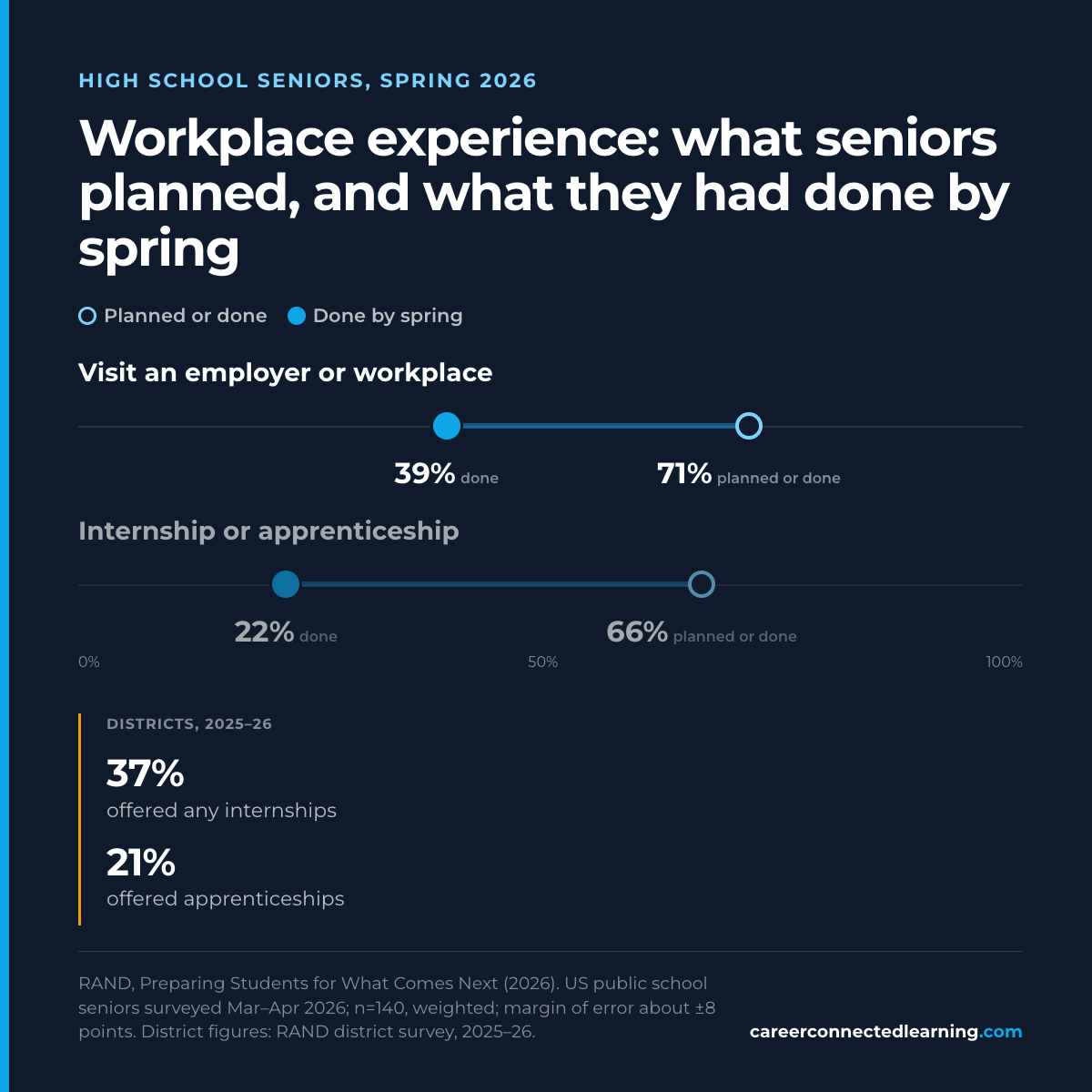
"By spring of their senior year, only 39 percent reported visiting an employer or workplace, even though 71 percent had planned to do so, and only 22 percent had actually participated in an internship or apprenticeship, even though 66 percent had planned to do so."
The plans and the experiences come from the same students in the same survey, so the two figures can be compared directly. Because the answer options didn't overlap, the 71 percent most likely includes seniors who had already visited as well as those still planning to. There are two limits. The senior sample is small, 140 students weighted to be nationally representative, so each figure carries a margin of error of roughly 8 points. And the survey ran from early March to early April, so some seniors may still have made a visit before graduating.
What RAND says about the gap
RAND doesn't pin the gap on one cause. Its authors write that it could reflect the level of support schools provide, the commitment of students and families, or some combination of both.
The report's district and principal surveys show how these experiences are offered and tracked. In the 2025–26 school year, 37 percent of districts offered any internships and 21 percent offered apprenticeships in any industry. Thirty percent of high schools set numeric targets for workplace visits and 26 percent for internships or apprenticeships; 59 percent set targets for FAFSA completion. Across all four high school grades, 66 percent of students said they heard a lot of emphasis from educators on attending a four-year college, and much less on other paths.
Workplace visits have the stronger evidence
Of the two experiences in RAND's data, workplace visits are the one with better research behind them. The OECD counts workplace visits and job shadowing among its confirmed indicators of teenage career readiness, based on studies following teenagers into adulthood; in Canada, people who had made an organized workplace visit by age 15 were 4 percentage points less likely to be out of work, education or training at 25. The OECD rates the evidence for teenage internships as only partial, and in US data it found no significant link between teenage internships and later earnings, career satisfaction, or being out of work and education. Our research summary covers both in more detail.
Job shadowing is also easier to host than an internship. The OECD says it is usually shorter and less likely to involve work limited by health and safety rules.
What college internship data shows
For college students, there is more data. In Talent Disrupted (2024), the Burning Glass Institute and Strada found that 54 percent of bachelor's graduates who hadn't had an internship in college were underemployed five years after graduating, compared with 41 percent of those who had. After adjusting for gender, race and ethnicity, and characteristics of the college, the odds of underemployment were 48.5 percent lower for graduates with at least one internship. That is a correlation, and it's about college students, not high schoolers.
The same report found that 52 percent of bachelor's graduates were working in jobs that don't typically require a bachelor's degree a year after graduating, and 73 percent of those who start out underemployed are still underemployed ten years later. The Burning Glass Institute reported the same 52 percent for the Class of 2023. These figures describe college graduates, a different group from the RAND seniors, and say nothing about whether missed high school visits lead to underemployment.
What employers can do
Whatever the cause, only employers can host visits. Visits take more of an employer's time than career talks (the OECD calls them "a bigger ask"), and they have stronger evidence than teenage internships. Here are three ways to take part.
- Offer workplace visits or job shadowing. Ask your chamber's education or workforce staff, or a district's CTE director, which schools are looking for hosts, and what permissions they need. Nebraska's state guidance on work-based learning, for example, says parents should give permission for transportation.
- Take part in career talks. The OECD says employers find them the easiest activity to support.
- Put your work into classroom projects. In Ohio@Work, employers supply their story, roles and a filmed workplace tour, and teachers use the resulting projects in core classes. A project in a core course reaches every student in every class that teaches it, and it can run alongside visits.
Our guide for employers compares these options in more detail.
Sources
- Master, Diliberti, Alvarez, Keskin & Steiner, Preparing Students for What Comes Next: Educator and Student Perspectives on Career-Connected Learning in K–12 Schools, RAND (RR-A5137-1, 2026)
- OECD, Indicators of Teenage Career Readiness: Guidance for Policy Makers (2021)
- Covacevich et al., Indicators of Teenage Career Readiness, OECD Education Working Paper No. 258 (2021)
- OECD, Internships for Secondary School Students in General Education (2025)
- OECD, Job Shadowing (2022)
- OECD, Getting the Most Out of Employer Engagement in Career Guidance (2021)
- Burning Glass Institute and Strada Institute for the Future of Work, Talent Disrupted: College Graduates, Underemployment, and the Way Forward (2024)
- Burning Glass Institute, No Country for Young Grads (2025)
- Nebraska Department of Education, Legal Questions Around Youth Work-Based Learning (2018)