Many American students say their school offers few career activities. In Gallup's 2024 survey for the Walton Family Foundation, apart from learning about different types of careers, each career-related activity it asked about was offered at the schools of 35 percent of students or fewer. Students whose schools did offer those activities were 6 to 16 points more likely to feel very prepared for their future career.
For an employer that wants to help, the options range from an hour at a career fair to a summer internship. They differ a lot in what they cost you and in how much evidence stands behind them. The OECD has studied this by following teenagers in several countries into their mid-twenties to see which school activities were linked to better adult outcomes.
Career talks and job fairs
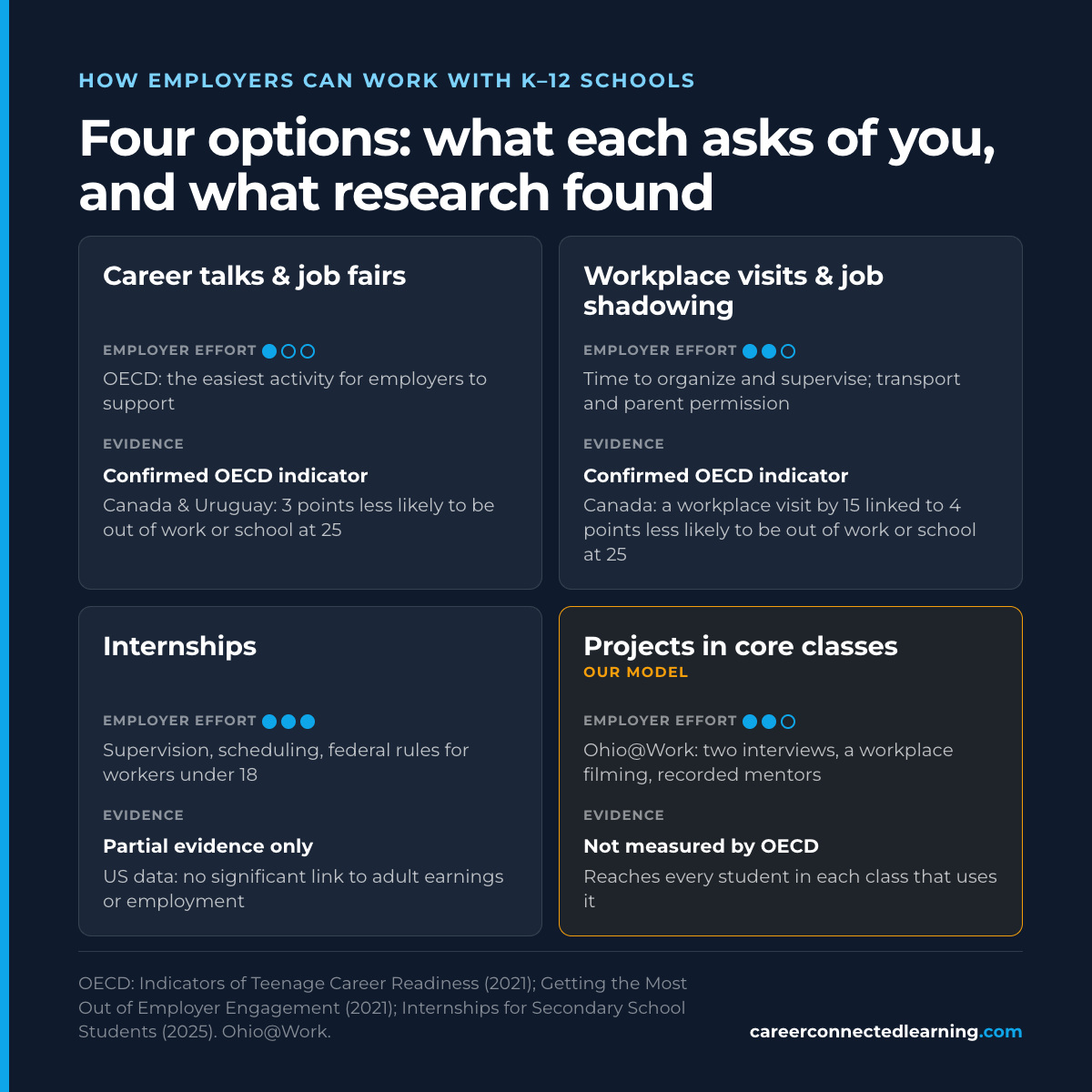
This is where the OECD suggests employers start. Its 2021 guidance calls career talks "the simplest place to start" and says employers find them "the easiest activity for them to support." One format the OECD describes is a carousel, where students rotate through several volunteers in about an hour.
The OECD counts career talks and job fairs among its confirmed indicators of teenage career readiness. In Canada and Uruguay, young people who had attended a career talk by age 15 were 3 percentage points less likely to be out of work, education or training at 25. The same research found no significant link to earnings.
Workplace visits and job shadowing
Bringing students on site is a bigger ask. The OECD notes that the employer "needs to spend more time helping to organise and oversee the activity." Nebraska's state guidance adds that parents should give permission for transportation.
It is also a confirmed indicator, with positive associations found in four of the six studies the OECD reviewed. In Canada, people who went on an organized workplace visit by age 15 were 4 percentage points less likely to be out of work, education or training at 25. In Australia, those who took part in a school-organized workplace visit by 15 or 16 earned 9 percent more at 25. A UK study found job shadowing before age 16 was associated with 11 percent higher adult wages, though only 9 percent of respondents had done it.
The OECD says job shadowing is usually easier for employers to organize than an internship because it's shorter and "much less likely to include activities that can be constrained by health and safety considerations."
Internships
In a 2024 survey of 500 employers by American Student Assistance, the biggest barriers to hosting high school interns were working out what work suits them (43 percent), attracting qualified interns (42 percent) and scheduling around their availability (39 percent).
Under the Fair Labor Standards Act, 16- and 17-year-olds can work unlimited hours in any job except those covered by 17 hazardous occupations orders, which include driving motor vehicles and operating power-driven woodworking machines. Fourteen- and 15-year-olds are limited to 3 hours on a school day and 18 hours in a school week. Nebraska's state guidance on work-based learning recommends designing placements for students 16 and older. It also notes that general liability premiums shouldn't rise because minors are on site, and that workers' compensation costs are based on wages, not age.
Internships ask the most of an employer, and their evidence is weaker than for talks or visits. The OECD found only partial evidence for work placements: six of eight studies found some evidence of better employment outcomes, but "overall, the data is less conclusive." In US data, only 5 percent of students had done a teenage internship, and it showed no significant association with being out of work or education, earnings or career satisfaction.
Projects built into core classes
In a fourth option, your company's work becomes the context for lessons in subjects every student takes. Ohio@Work, an Ohio Chamber of Commerce initiative whose research foundation was one of five 2026 grantees the U.S. Chamber of Commerce Foundation chose from nearly 200 applicants, works this way. Employers supply their story, the roles they hire for, a workplace tour (Defined films it or uses existing footage) and two to four employees' recorded answers to the same fifteen questions. Defined builds that material into projects aligned to Ohio's learning standards, and the employer approves them before they go live. One example is an Algebra II unit built with Air Transport Services Group, in which students model an air-cargo loading problem using systems of inequalities.
This format hasn't been studied the way talks and visits have, and it isn't one of the OECD's indicators, so we won't claim outcomes for it. A career talk reaches the students in the room that day, while a project in a core course reaches every student in every class that teaches it. It can run alongside talks and visits rather than replacing them.
Why the number of activities matters
A 2017 UK study by Education and Employers looked at how many employer activities students did, not which ones. Young adults who recalled four activities at school were 86 percent less likely to be out of work, education or training than those who recalled none, after adjusting for background. The authors recommend four or more interactions per student as a minimum. One employer can't supply that alone, so it usually takes several employers in a region, each taking one option. The research article goes into that study in more detail.
Where to start
Pick the option that fits the time your people actually have. For career talks, ask your local chamber's education or workforce staff, or a district's CTE director, which schools are looking for speakers. If you can host visitors, start with job shadowing before internships. If you'd rather not host, talk to us about classroom projects.
Sources
- Walton Family Foundation and Gallup, Voices of Gen Z, Year 2 report (2024)
- OECD, Getting the Most Out of Employer Engagement in Career Guidance, Education Policy Perspectives No. 36 (2021)
- OECD, Indicators of Teenage Career Readiness: Guidance for Policy Makers, Education Policy Perspectives No. 43 (2021)
- Covacevich et al., Indicators of Teenage Career Readiness, OECD Education Working Paper No. 258 (2021)
- OECD, Job Shadowing, Education Policy Perspectives No. 62 (2022)
- OECD, Internships for Secondary School Students in General Education, Policy Brief No. 117 (2025)
- Mann, Kashefpakdel, Rehill & Huddleston, Contemporary Transitions, Education and Employers (2017)
- American Student Assistance, employer survey on high school internships, press release, May 7, 2024
- US Department of Labor, Fact Sheet #43: Child Labor Provisions for Nonagricultural Occupations
- Nebraska Department of Education, Legal Questions Around Youth Work-Based Learning (2018)
- Ohio@Work, ohioatwork.com