In July 2026 the U.S. Chamber of Commerce Foundation chose five grantees from nearly 200 applicants for Pathways with Purpose, its initiative for employer-led career pathways that connect K–12 schools to local workforce needs. One was the Ohio Chamber of Commerce Research Foundation, which plans to work across Montgomery and Warren counties to involve advanced manufacturing and health sciences employers in what students learn. The Foundation estimates the effort will reach 77,000 students.
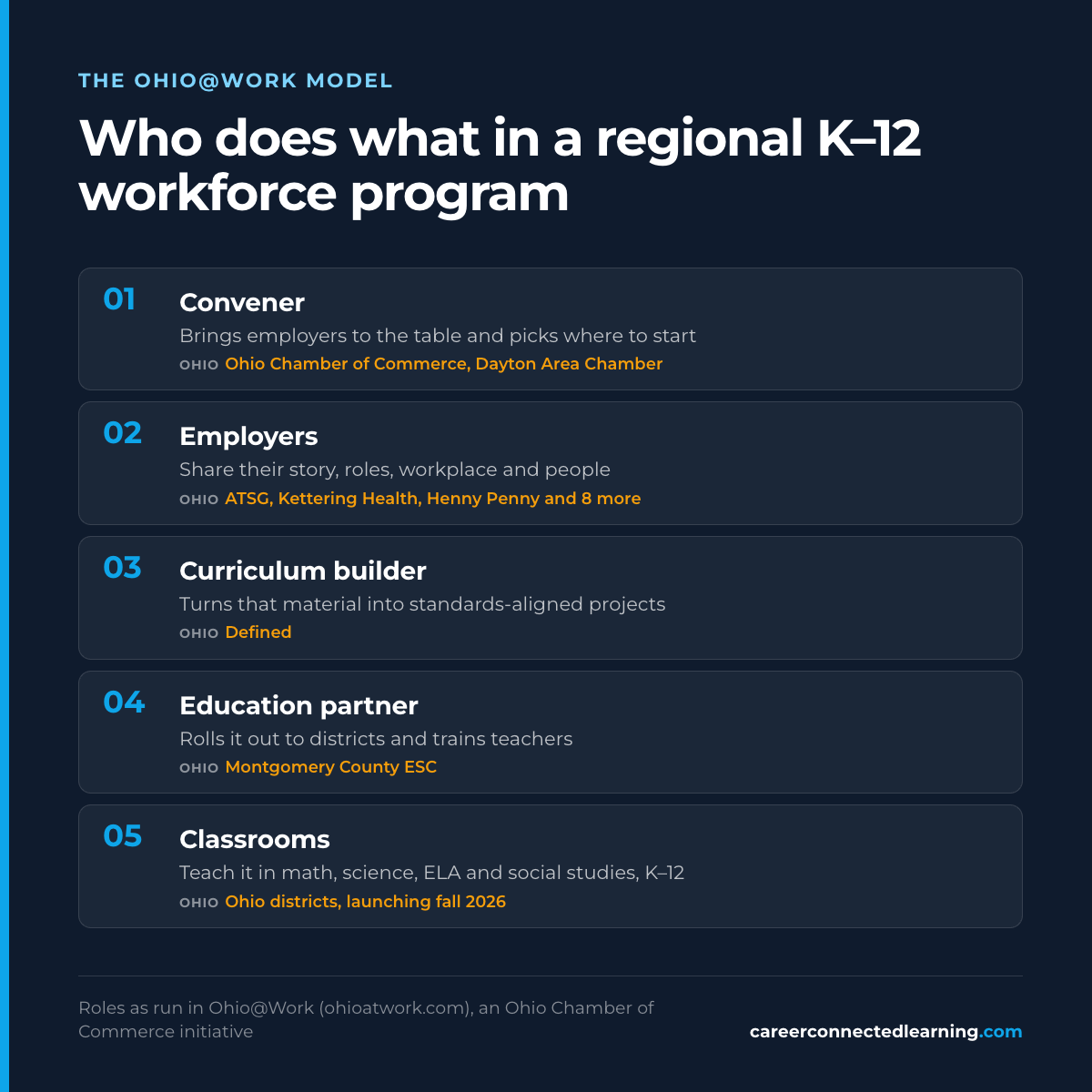
The program is Ohio@Work. Ohio employers supply material about their work, Defined turns it into standards-aligned projects, and teachers use those projects in math, science, English and social studies. Below is how it's set up, for chambers, workforce boards and employer groups weighing something similar. (Defined, which runs this site, is the program's curriculum and platform partner.)
What a chamber brings
A chamber usually already knows the region's employers and often has ties to superintendents and school boards, so it can recruit on both sides at once. It also knows which industries in the region are hiring, which is where a program like this should start.
Since 2014 the U.S. Chamber of Commerce Foundation's Talent Pipeline Management framework has described employers as "end-customers" of education and workforce partnerships. That framework wasn't built for K–12; it added CTE resources in 2019 and 2020. Ohio@Work, which the Foundation also backs, takes a similar employer-led approach into elementary, middle and high school classrooms.
Start with two industries and one pilot area
The first phase of Ohio@Work covers two counties and two industries, advanced manufacturing and health sciences, with classroom use beginning in fall 2026. Stephanie Keinath, executive vice president of the Dayton Area Chamber of Commerce, told the Dayton Daily News that Montgomery County is "a pilot" for use statewide.
Choose the education partner early
Ohio@Work's own site names the risk plainly: "Most corporate education initiatives fail on distribution — good material nobody teaches." The program addresses it in two ways.
It brought in Montgomery County ESC, the education service center that works with districts across the county and handles implementation and teacher training for the program. An ESC, BOCES or intermediate unit already works with many districts, which makes it a practical first partner.
And the projects ship through Defined, a platform many districts already license, rather than as a separate website teachers would have to find.
Tell employers exactly what you need from them
Ohio@Work asks each employer for five things:
- The basics: name, Ohio locations, logo and size, on a form that takes about ten minutes.
- The company's story: what it makes or does, its footprint in the state and where it's growing. One interview.
- The careers it hires for: the roles, the technical and durable skills each one needs, the entry point and expected hiring. A second interview.
- A workplace tour: three or four spaces, with the equipment and the work labeled, filmed on site or pulled from footage the company already has. Students take the tour on video.
- Recorded mentor interviews: two to four employees answer the same fifteen questions on camera, once. Students watch the recordings; there is no live contact.
Defined's instructional designers turn that into lessons and send them back for the employer to approve before anything goes live.
The Dayton Daily News reported that the program will also include virtual job shadowing for middle and high school students. Amanda Byers, the Dayton Area Chamber's senior director of talent and policy, described the goal: students "will get to experience what it's like to be a nurse at one of our specific local hospitals or what it's like to be a machinist at one of our local manufacturers."
Where the lessons reach students
Ohio@Work builds its projects for math, science, English and social studies, classes every student takes, not only those in CTE programs. The projects are aligned to Ohio's learning standards, so a teacher using one is covering material they're already required to teach.
The catalog on ohioatwork.com already lists employers beyond the pilot's two industries. One example is an Algebra II unit built with Air Transport Services Group, an air cargo company in Wilmington: students model an air-cargo loading problem using systems of inequalities. The math is standard Algebra II; ATSG supplied the scenario.
Decide what you'll report
Boards will ask what the program produced. Useful first-year counts are employers featured, projects approved, and the districts, teachers and grade levels using them. Whether students later choose local careers is a multi-year question, best measured in aggregate through districts or state data, never by sharing student information with employers.
If you run a workforce board
A workforce board can play the convener role too. Under federal law, at least 75 percent of WIOA youth funds go to out-of-school youth, and in-school youth generally must be low-income and face at least one listed barrier. A K–12 program for all students will usually sit alongside WIOA youth services rather than inside them. What a board brings is its labor market data: the in-demand occupations in your local plan are a ready list of careers to feature.
Other chambers doing K–12 work
The Nashville Area Chamber of Commerce was a founding partner of the Academies of Nashville, alongside Alignment Nashville and PENCIL, and runs partnership councils that bring together volunteer business leaders and Metro Nashville educators. The NC Chamber Foundation built a K–12 talent pipeline toolkit with North Carolina's Department of Public Instruction in 2024 and is another 2026 Pathways with Purpose grantee. Ohio@Work's distinguishing feature is delivery: its employer content ships as standards-aligned projects inside existing core courses.
Sources
- U.S. Chamber of Commerce Foundation, Pathways with Purpose grantee announcement, July 8, 2026
- Dayton Daily News, "New Dayton program aims to develop virtual job shadowing opportunities for kids," July 25, 2026
- Ohio@Work, ohioatwork.com
- U.S. Chamber of Commerce Foundation, Talent Pipeline Management history, 2025
- 29 U.S.C. § 3164, WIOA youth workforce investment activities
- Nashville Area Chamber of Commerce, Academies of Nashville partnership council
- NC Department of Public Instruction and NC Chamber Foundation, K–12 talent pipeline toolkit, February 2024