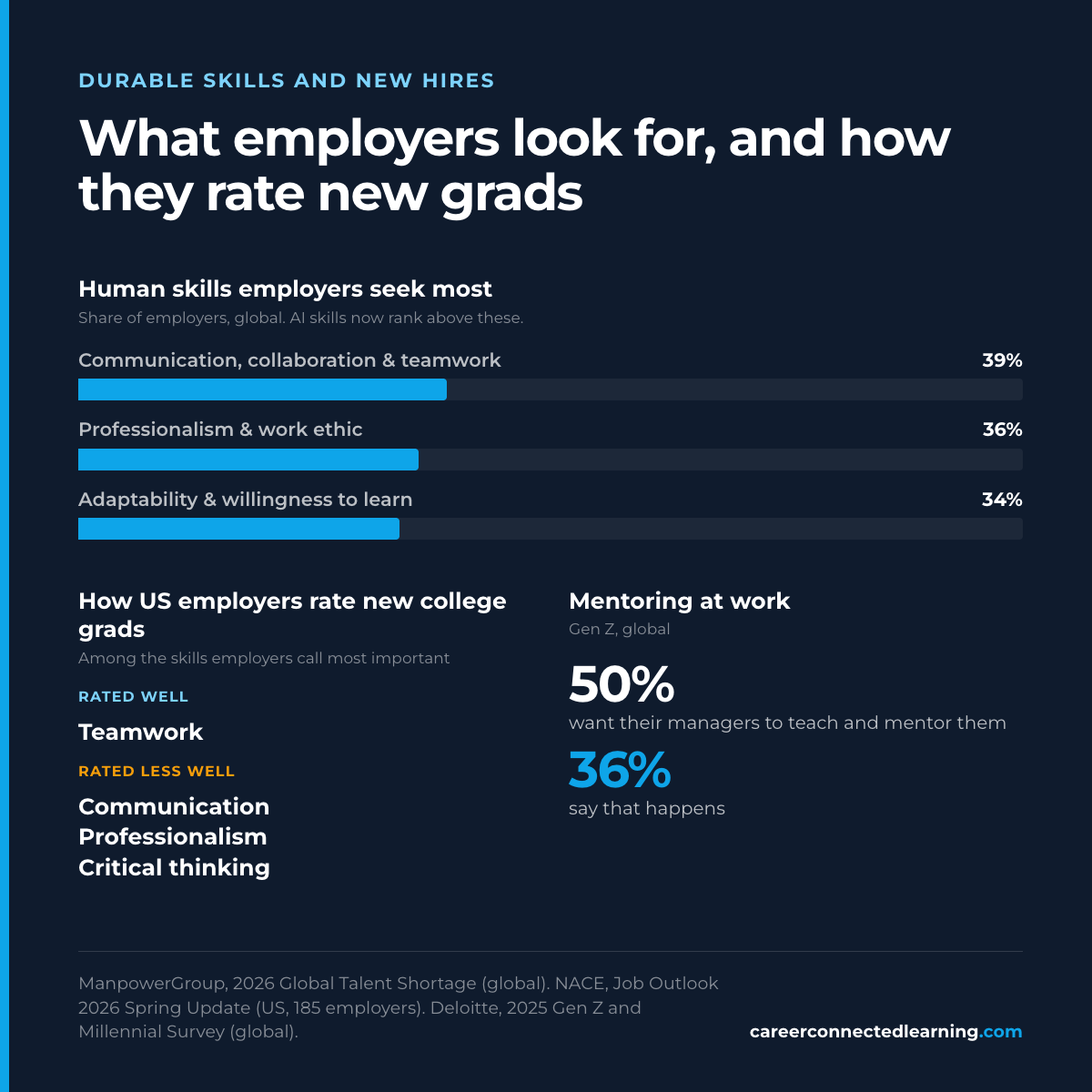
In its Job Outlook 2026 Spring Update, the National Association of Colleges and Employers surveyed 185 employers about new college graduates. They said they see communication, teamwork, professionalism and critical thinking as the most important skills in new hires. They gave new grads "high marks for their teamwork abilities," but were "less impressed with new grads' communication, professionalism, and critical thinking skills."
NACE's headline is that new grads are largely prepared; more than 20 percent of employers rated them very well prepared. The weaker ratings fell on three of the four skills employers called most important.
How often employers ask for these skills
Lightcast and America Succeeds call these durable skills. Their 2025 analysis of more than 75 million US job postings found that 76 percent requested at least one durable skill and 47 percent requested three or more, up 13 points since 2021. Eight of the ten most requested skills were durable skills. In NACE's Job Outlook 2026 survey, 70 percent of employers reported using skills-based hiring, up from 65 percent the year before.
ManpowerGroup's 2026 survey of more than 39,000 employers in 41 countries finds that AI skills now top the list. Among human skills, the most sought after were communication, collaboration and teamwork (39 percent of employers), professionalism and work ethic (36 percent), and adaptability and willingness to learn (34 percent).
What young workers say about mentoring
In Deloitte's 2025 survey of more than 23,000 people in 44 countries, more than eight in ten Gen Zs and millennials said developing soft skills, "like empathy and leadership," is even more important for career advancement than honing technical skills.
The same survey found that half of Gen Z (50 percent) want their managers to teach and mentor them, and 36 percent say that happens. These are global figures, not US-only.
Why practice should start in school
This part is our argument rather than a research finding. NACE's survey is about college graduates. If employers still see room to improve by college graduation, the practice should start earlier, and K–12 school is where students spend years before they work.
Communication and professionalism improve with repetition in realistic situations, for example explaining a recommendation to someone who will act on it. Career-connected projects can put that into ordinary classes. In Ohio@Work, each project is built around a real Ohio employer, and every one builds and assesses durable skills including communication, collaboration, critical thinking, problem solving and professionalism alongside its academic standard. Classroom projects like these haven't been studied the way career talks and workplace visits have, so we don't claim outcomes for them. What they offer is repeated practice inside the core classes students are already required to take.
What employers can do
Tell schools which durable skills matter most in your roles, and what good looks like. If a district near you has a CTE advisory committee, that's one place for it. If you want students to practice against your standard, classroom projects built around your work are one way to do it. In Ohio@Work, employers name the roles they hire for and the technical and durable skills each needs, and the projects build and assess those skills. Our guide for employers compares the other options.
Sources
- NACE, "Employers Say New Grads Are Largely Prepared for Work, With Room to Improve," Job Outlook 2026 Spring Update (April 2026)
- NACE, "Employer Use of Skills-Based Hiring Practices Grows," Job Outlook 2026 (January 2026)
- Lightcast and America Succeeds, Durable by Design (2025)
- ManpowerGroup, 2026 Global Talent Shortage
- Deloitte, 2025 Gen Z and Millennial Survey (May 2025)
- Ohio@Work, ohioatwork.com